The 32nd Eidgenössisches Jodlerfest (Swiss Federal Yodel Festival)
From June 26-28, Basel will be steeped in music, conviviality, and Swiss traditional customs when it hosts the 32nd Eidgenössisches Jodlerfest (Swiss Federal Yodel Festival). Under the motto “Stadt und Land mitenand” (City and country together), over 12,000 performers will take part in yodeling, alphorn playing, and flag throwing.
A Brief History of the Swiss Yodel Festival

In order to preserve the Swiss traditions of yodeling, alphorn playing, and flag throwing, the Swiss Yodeling Association was founded in Bern in 1910. In the early years, yodelers primarily performed as part of the Swiss wrestling and Alpine games (Schwingfeste), rather than having their own dedicated event. Under the yodeling association’s new name—Eidgenössischer Jodlerverband (EJV; Federal Yodeling Association)—they decided to host their own official national event in 1924. This first Eidgenössisches Jodlerfest took place in Basel, and featured 31 groups, including 48 male yodelers and just two female yodelers, along with 16 alphorn players and 17 flag swingers. Since its inception, the festival has grown significantly and is now typically held every three years in a different Swiss location. After nearly 100 years, it was scheduled to make it’s return to Basel in 2020, but had to be cancelled due to the Covid-19 pandemic. After the last edition, which took place in Zug in 2023, the 32nd edition of the Eidgenössische Jodlerfest will finally be returning to Basel in June, 2026!
The Swiss Traditions of Yodeling, Alphorn Playing, and Flag Throwing

Yodeling: The English word “yodel” is derived from the German word“jodeln,” meaning “to utter the syllable jo” (pronounced “yo”). In this syllabic singing style, the melody alternates between chest and head voice. While this vocal technique is used in many cultures worldwide, yodeling originated in the Central Alps of Europe (specifically Switzerland, Austria, and Germany) as a functional, long-distance communication method for herders calling to their flocks and as a means of communication between Alpine villages. The earliest recorded instance of this Alpine technique is from 1545, identifying it as a cowherd call from Appenzell. In the 19th century, yodeling evolved into a musical art form with different regional styles around Switzerland. In December 2025, Swiss yodeling was officially added to the UNESCO List of Intangible Cultural Heritage of Humanity, cementing its global importance as a living tradition. At the Eidgenössisches Jodlerfest, yodelers are judged by a jury for their performances, either individually, in duets, as a trio, as a quartet, or as a choir.
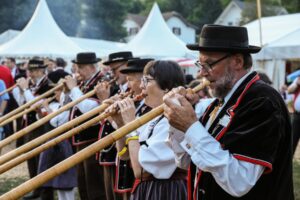
Alphorn: Natural horns and cow horns are among the oldest wind instruments. In the 16th century, the alphorn was traditionally made in one piece from the trunk of a pine and served a signaling function for communication with the herdsmen on the neighboring alpine pastures and with the people down in the valley below. Modern alphorns are usually made in three detachable sections for easier transport and handling, carved from blocks of spruce. The modern alphorn, as played in Switzerland, is a wooden tube approximately 3.4 meters long (typically 10-13 feet). It tapers from bottom to top (narrowing towards the mouthpiece). Only notes within the natural harmonic series can be played. Alphorns have different fundamental pitches depending on their length. They are played by soloists and in groups. A type of alphorn called “Büchel” also can be heard at competitions. Alphorn players perform for the judges at outdoor venues during yodeling festivals. Around 600 alphorn players, performing in various formations, are judged by experts at the Eidgenössisches Jodlerfest in Basel.

Flag throwing: The ancient traditional art and competitive sport known as “Fahnenschwingen,” which is most notably performed in Switzerland, involves the skillful manipulation, waving, and tossing of a flag high into the air. It combines choreographed motion, balance, and precision and is often performed in traditional costumes to music. The alpine herdsmen from the central Swiss cantons were already waving short-handled flags (120 x 120 cm) before the 16th century. Since 1922, flag throwers have been part of the Swiss Yodeling Association. In a competition, participants have numerous throws at their disposal, which they perform in a choreographed routine with both hands for three minutes. The judges can deduct points based on various criteria, for example, if the participant steps outside the 150-cm circle in which they are standing. There are solo and duet performances. Around 200 flag throwers will compete individually or in pairs at the Eidgenössisches Jodlerfest in Basel, facing the strict criteria of the jury, who will be looking for precision, speed, height of throws, and the use of both hands.
In order to participate in the Eidgenössisches Jodlerfest, all yodelers, alphorn players, and flag throwers must first participate in their regional yodeling festival and meet the requirements of the EJV. The over 1,000 presentations, in 10 churches and concert halls in the city center, will be evaluated by an expert jury using a 1-to-4 grading scale: 1=very good, 2= good, 3= average, and 4= Unsatisfactory.
The 2026 Festival in Basel
At this year’s festival in Basel, visitors can expect more than 1,000 judged presentations in 10 churches and concert halls in town, including the Münster, Martinskirche, Stadtcasino, Marienkirche, Leonhardskirche, Peterskirche, auditorium of Universität Basel, Predigerkirche, Leonhard school, and St. Johann school, as well as spontaneous presentations in the festival area and on three open stages.
The yodeling village on Petersplatz, the yodeling mile near the adjacent Petersgraben, and the yodeling hill—the area leading from Petersplatz to the Marktplatz with its many old town alleyways in and around the Spalenberg, Nadelberg, Heuberg, and Gemsberg—will form the festival perimeter, where participants and visitors can mingle while immersing themselves in the quintessential Swiss soundscape. On Sunday, the official ceremony on the Marktplatz and the festive colorful parade through the city center, with around 1,500 participants in over 60 groups from all over Switzerland, are also predicted to be major crowd-pleasers. Numerous small and large food and drink stalls and stands will be set up throughout the city center to cater to the over 200,000 guests that are expected to attend this massive cultural event in Basel, one that will be on the scale of the Basel Fasnacht.
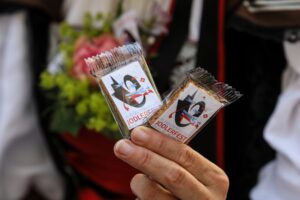
Attending is simple, as entry to the festival grounds is free. However, like at the Basler Fasnacht, it is a tradition and “matter of honor” for visitors to purchase and wear the official festival badge to support the event. While not obligatory, purchasing the so-called “Jodlerfest Blaggedde” (CHF 10) shows a sign of support for the festival and its participants.
An entrance fee is required to attend the yodeling, alphorn playing, and flag throwing presentations in the 10 venues where judged performances take place. Entry to these events requires a wristband that costs CHF 15 for the Friday events and CHF 20 for the Saturday events, free for kids and youths up to age 16. The very handy printed festival guide is CHF 12. Visitor packages are also available that include the badge, entry to performance venues, and public transport for the Basel region; they cost CHF 28-49. Note that seats are not numbered and cannot be reserved. The doors will open between presentations when people are free to enter or leave,
Individual festival badges, wristbands, and the festival guide can be purchased on site at the ticket counters of all 10 presentation venues, at the Basel Tourismus Shop at Barfüsserplatz, at the Tourist Info Liestal, (Rathausstrasse 30, Liestal), at the Geschäftsstelle 32. Eidg. Jodlerfest, at Kasernenhof 8 in Basel, at the festival’s information pavilion at the Basel SBB, as well as on their online shop at https://shop-jodlerfest.ch/i/festsets.
https://www.jodlerfestbasel.ch/home.html
ShareAdvertisement